
Political Voices
Perspective from Party Leadership
Iowans Deserve Clean Water — And We’re Making Progress
It’s Time To Pass The Iowa Healthy Water Act
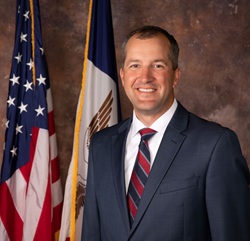

By Mike Naig, Iowa Secretary of Agriculture
Every Iowan deserves clean, safe drinking water. That’s not negotiable. It’s fundamental to our health, our communities, and our quality of life. As Secretary of Agriculture, protecting our natural resources while keeping Iowa agriculture strong has been one of my top priorities. Those goals are not conflicting – they go hand in hand.
Let’s start with the facts. Iowa’s treated drinking water meets national safety standards, which are regularly reviewed and updated, most recently in 2024 under the Biden administration. At the same time, we know there is more work to do upstream to continue improving water quality, and we are making significant progress across our state.
Iowa is an agricultural powerhouse because we are blessed with naturally nitrogen-rich soils. Nitrogen is essential for crops to grow but can create challenges if it leaves the field and enters waterways. That’s why farmers across our state are implementing thousands of responsible farming practices that keep soil in place, reduce runoff, filter nutrients, and protect downstream water sources.
In 2024, Iowa farmers planted nearly 4 million acres of cover crops, up from fewer than 400,000 just a decade ago, a 10x increase. Cover crops hold soil and nutrients in place, improve soil health, and are a good source of forage for livestock.
Farmers are also building nitrate-reducing wetlands, which capture and treat thousands of acres of water as it leaves the field, reducing nitrate runoff by up to 90 percent. Over 150 wetlands have been constructed statewide, and our pace is accelerating; nearly three times as many wetlands have been built in the past four years compared to the previous two decades.
In addition, farmers have installed nearly 500 nitrate-filtering buffers along field edges, all of which capture and treat water before it reaches streams. Again, the pace has increased dramatically, with practices installed about five times faster in the past four years than in the previous decade.
These are measurable, science-based practices being implemented on real farms across Iowa every day — not because of mandates, but because farmers want to be part of the solution.
The State of Iowa invests nearly $100 million annually in water quality programs, including $3 million allocated to the Iowa DNR’s water quality monitoring network. The state’s water quality investment is matched by roughly $500 million in federal funding, with additional investment from private individuals and organizations. These resources help farmers adopt conservation practices and accelerate implementation of the Iowa Nutrient Reduction Strategy.
We are seeing results. Iowa has spent decades investing in soil conservation, and because of that commitment, we are close to achieving our phosphorus reduction goals. Nitrogen reduction efforts began in 2013 and are now accelerating with targeted practices, investments and partnerships, especially in priority watersheds.
And that brings me to an important point: water quality is not solely a farm issue or a city issue. It requires a system-wide approach.
Many of Iowa’s water treatment and wastewater systems were built decades ago and need modernization. Just as farmers are stepping up conservation practices, municipalities and industry must continue investing in infrastructure and nutrient removal technologies. Both sides of the system matter — from the farm to the faucet.
Unfortunately, many Democrat politicians argue the answer is more government, more red tape, and more taxes on farmers. Republicans disagree.
Mandates and one-size-fits-all regulations would raise costs dramatically for farm families, and those costs get passed on to consumers through higher prices at the grocery store and fuel pump. Heavy-handed regulation hits small and mid-sized farms hardest, squeezing them out. The result? More consolidation in agriculture, and that’s bad for our farm families, bad for beginning farmers, bad for our rural communities, and bad for consumers.
We should be strengthening family farms, not taxing and regulating them out of existence.
This debate comes down to a choice: Do we continue Iowa’s community-led, collaborative, science-based approach that is delivering progress — or do we move toward costly mandates that punish farmers and increase prices for Iowa families?
Iowa has chosen a path built on partnerships, incentives, innovation, and measurable outcomes.
That approach is working. Farmers are scaling up conservation faster than ever. Investments are increasing. Collaboration across agriculture, conservation groups, municipalities, and state agencies is stronger than it has ever been.
Progress takes time, especially when addressing challenges that developed over generations. But Iowa is moving forward — and faster than many realize.
We can and must continue to invest, innovate, and work together to protect our water while also protecting family farms and keeping food and fuel affordable.
By State Representative Elinor Levin
Every Iowan, every human, needs water to survive. Whether to drink, to grow plants, to fish, swim, kayak, and paddle, or to uplift amazing local breweries, wineries, and cideries, the water we access simply must be healthy and plentiful for us to have a future.
Right now, Iowans across the state are recognizing and speaking out about the fact that we have a real water challenge. And they are no longer asking us to make a change. Some are begging, some are demanding, and some are crying out from their children’s hospital rooms.
And Iowa doesn’t start from a great position- unlike many states, we don’t have a strong understanding of our water resources. Without the underground data of a century-old oil and gas industry; without monitoring of non-point sources; without fully funding our State Geologist’s office like other states do to map aquifers; and without finding the funds for the Iowa Flood Center to maintain and grow the Iowa Water Quality Information Sensor network; we have pieces of a very big puzzle, but too many are missing.
What do we know? Our waters are impaired, but our majority leaders want to stop looking, stop monitoring, and stop protecting us. Our well levels are dropping, but water use permits are still under consideration that would send Iowa water out of state. And Iowans, so, so many Iowans, are sick. Young people being diagnosed with cancer flood our social circles. Autoimmune disease. Complications in pregnancies. Stories every week from and about our friends and neighbors.
So, how do we find the other pieces? House Democrats have proposed a few places to start with the Iowa Healthy Waters Act. First, the Act fully funds the statewide water monitoring program at $600,000. Next, it triples funds for the voluntary nutrient reduction strategy, allowing partners across the state to enroll all willing land stewards and get the practices in place from the Mississippi to the Missouri River. Finally, the Act recognizes the foundational role farmers can play, right in our soil, in improving our water statewide, but they need state and federal policies that make regenerative agriculture financially feasible for more producers. When policy supports farmers who embrace best practices for nitrate reduction, including wetlands, buffer strips, bioreactors, and cover crops, we take the first steps towards healthy water for the entire state.
We simply must bring in every Iowan to be a part of the solution, and we really can. Whether we drink and paddle, whether we till and sow, whether we float and noodle, or whether we do all of it, water is in all of our futures, and now is the time to fight for it.
State Representative Elinor Levin is a Democrat from the Iowa House District 89 in Iowa City and is the Ranking Member of the House Natural Resources Committee.